Showing posts with label Halmstad University. Show all posts

Thursday, October 6, 2011

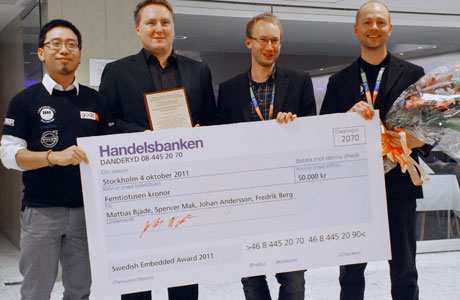
Halmstad GCDC team wins Swedish Student Embedded Award


Yesterday it was announced that the Grand Cooperative Driving Challenge student team from Halmstad University won the Swedish Embedded Award in the "Student" category. The prestigious prize is awarded every year to promising projects and products that make use of intelligent embedded systems. Congratulations!


Saturday, February 26, 2011

GCDC Testing


Last week we did some closed-track testing here in Halmstad with our GCDC vehicle to verify the control interface and on-board sensors.

Thursday, January 20, 2011

Return to Helmond

The GCDC communications workshop is underway in Helmond, NL hosted by TNO and Halmstad as part of the Swedish CoAct team is of course in attendance. In summary, after two intensive hacking and workshop days most teams have gotten their communications gear up and talking to the other teams. Today's program also included a few test-runs to verify interoperability with the RTK-GPS base station to be used during the competition in May.

Strange enough, building wireless systems always seems to include a lot of wires.

Competition infrastructure along the A270 highway between Helmond and Eindhoven.

Monday, January 10, 2011

GCDC Team Trailers

The Grand Cooperative Driving Challenge will take place in May, below you will find team trailers for some of the other participating teams:

Team AnnieWAY:


University of Latvia:


Team MIRA:


A-Team:

Tuesday, December 7, 2010

GCDC CoAct trailer

We are currently participating in the Grand Cooperative Driving Challenge together with several other teams both from Sweden and and other parts of the world. The Swedish teams are coordinated through the CoAct project. In a competition like GCDC where your success in the competition depends on your ability to cooperate with others most of the coordination actually takes place before the competition in the form of workshops and compatibility testing. One of the requirements for participating in the competition is to present your team by creating a team movie. The short 60 s trailer for the CoAct team movie can be seen below (a longer 5 minute version is in the works):

Tuesday, May 18, 2010

IEEE Intelligent Vehicles Symposium 2010

We recently got word that our article, "A Spatial QoS Requirements Specification for V2V Applications", where we present a construct for specifying VANET application QoS requirements was accepted to the IEEE Intelligent Vehicles Symposium to be held in San Diego June 21-24.

The construct for expressing QoS requirements is based on the "T-Window Reliability" metric proposed by Bai and Krishnan combined with a novel way of specifying spatial coverage requirements. The need to specify spatial coverage in a more detailed form than just "range" is something we have discovered through our measurements of V2V communication reliability in various environments.

See you in San Diego!

Thursday, March 18, 2010

5.9Ghz car-to-car measurements

To get a feeling for how well car-to-car communication actually works on the 5.9Ghz ITS band we went on a test-drive last week. We equipped two vehicles and ran through a number of interesting scenarios such as:
  • Travelling in different directions on the highway (~240 km/h relative speed)
  • Driving in urban areas with multi-storey buildings
  • Rural areas, especially at hilly locations/crests
  • Flat areas with clear line-of-sight.
  • Driving in the same direction on the highway with large trucks between transmitter and receiver

Although we had been expecting it, the correlation between line-of-sight and packet-reception-rate (PRR) was surprisingly clear. The picture below shows PRR as a function of location in the urban scenario. The yellow marker indicates where the transmitting vehicle was parked as we circled the block with the receiver. Green bars show locations with almost no packet-drops while just around the corner all packets are dropped. Ways of handling situations with such poor reception is the current focus of my research, the results from these preliminary test drives really emphasize the need for solutions to communication "black spots".


We are using the MatLab Google Earth toolbox to create these visualizations, highly recommended!

Wednesday, February 17, 2010

CVIS + CERES collaboration report

For the past few years the Cooperative Vehicle-Infrastructure Systems (CVIS) project has been working to enable vehicles to talk to each other and to infrastructure in order to enable safer, greener and more fun transportation. In parallel our lab at Halmstad University has been working towards the same goals within the Vehicle Alert System (VAS) project. As CVIS nears its end we summarized our work together in a report which is now available from the CVIS website.

"Parallel activities bring CVIS results closer to deployment

We have received the final report on the collaboration activities between CERES/VAS and CVIS, one of the 14 projects we are cooperating (or currently discussing cooperation) with: CVIS grants use of CVIS Reference Execution Platform, Core Software and CVIS Software Developers’ Kit in exchange for external testing and evaluation (see Third Party Cooperation section of this website).

In March 2007, an agreement was made for interchange of experiences between CVIS and the Centre for Research on Embedded Systems (CERES) at Halmstad University in Sweden. The majority of the work relating to this collaboration has been conducted within the CERES project Vehicle Alert System (VAS), aiming to use vehicle-to-vehicle (V2V) and vehicle-to-infrastructure (V2I) communications to provide different types of warning messages. The main focus of the VAS project is on communication and in particular the lower layers of the communication stack are investigated."