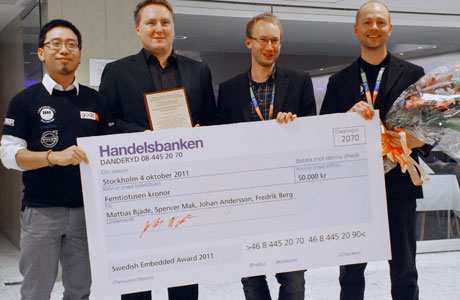
Yesterday it was announced that the Grand Cooperative Driving Challenge student team from Halmstad University won the Swedish Embedded Award in the "Student" category. The prestigious prize is awarded every year to promising projects and products that make use of intelligent embedded systems. Congratulations!
Thursday, October 6, 2011
Halmstad GCDC team wins Swedish Student Embedded Award
Yesterday it was announced that the Grand Cooperative Driving Challenge student team from Halmstad University won the Swedish Embedded Award in the "Student" category. The prestigious prize is awarded every year to promising projects and products that make use of intelligent embedded systems. Congratulations!
Monday, April 11, 2011
Testing@CityArena
The clip below shows a (slightly faster than ours) lap of the track.Monday, March 28, 2011
Truckin'
Thursday, March 24, 2011
Stora Holm testing, day 2
Below is a picture of the MTi-G status screen on our main HMI (running on an Apple iPad)
Tuesday, March 22, 2011
Stora Holm testing, day 1
Today's testing helped weed out some communication bugs and at the end of the day all teams were able to communicate with each other with quite respectable range. Although basic communications were tested already at the workshop in Helmond in January this is the first time that we bring together the Swedish teams for testing in realistic in-vehicle conditions.
The picture below managed to capture the two Volvo S60's from Halmstad and Chalmers as well as the Scania truck from KTH.
Saturday, February 26, 2011
GCDC Testing
Monday, January 31, 2011
XSensible
The MTi-G is an attitude-heading reference system (AHRS) which fuses information from accelerometers, gyros, magnetometers, barometer and GPS. It's a pretty tiny unit and although space isn't an issue for us in the GCDC this is an important factor for future robotics projects here at Halmstad. Since we want to send as high quality information as possible about our own car to our "opponents" (our fellow platoon members) we'll be using the MTi-G for situations which are tricky to handle only with our Trimble RTK GPS (which has good absolute location precision but is pretty vulnerable to signal dropouts and doesn't provide very useful attitude data).
The documentation that came with the MTi-G was really nice and it was a pretty quick job to integrate it into our LCM-based system using its open serial communication specification.
The following video shows another XSens sensor (sans GPS) in action:
Thursday, January 20, 2011
Return to Helmond
Monday, January 10, 2011
GCDC Team Trailers
Team AnnieWAY:
University of Latvia:
Team MIRA:
A-Team:
Tuesday, December 7, 2010
GCDC CoAct trailer
Thursday, November 4, 2010
Open source 5.9GHz drivers and CALM FAST daemon
The stack contains modified drivers for Atheros wireless cards as well as a user-space daemon which allows one to communicate for example vehicle-to-vehicle or vehicle-to-roadside using the CALM FAST protocol. It's described in the accompanying doc as a "generic, light-weight, open-source IEEE 802.11p implementation for Linux, based upon the original CVIS implementation".
You can find code and documentation at the GCDC site.
Thursday, June 17, 2010
GCDC, it's official (well almost)

A while ago I wrote about the Grand Cooperative Driving Challenge workshop in Helmond, NL, organized by TNO. The registration period ended just a few weeks ago and it seems they've attracted quite a few interesting teams.
Last minute changes to the competition timeline and scope have probably caused quite a lot of replanning to take place, I know it did for us at least. The following is from the GCDC website:
"After early registrations at the Intertraffic event from Latvia, Turkey and three Dutch consortia, the international dimension of the GCDC is enlarged by confirmations from Germany, UK and two consortia from Sweden. At this moment France and Poland are still investigating possibilities. Overseas Canada, United States, and Australia indicate they are still ftrying to find their way across to Helmond.
Registration period extended
Although the registration closure date for the 2011 event is officially past, as mentioned above, there is still strong interest from different parties. The process of finding the right partners and forming the needed consortia seems to take more time than expected, especially because the event has been moved ahead to march. Different parties are still considering participation, but stated to need more time to point all elements in the same direction. To allow this and to provide every interested team time to realize their final ‘go’, the GCDC has decided to extend the registration period.
Participants: clash of knowledge
It looks like the first GCDC will become a real clash of knowledge. Among the registered teams we find a high number of research institutes, most of them backed with car manufacturers.
On the Dutch part 3 mayor Universities active in the field of ITS and cooperative driving are participating: Technical University Eindhoven created a partnership with TMC and Daf. Fontys Institute has teamed up with TU Twente, and HAN Institute of Automotive Engineering forms the last of the Dutch pack.Fitting into the program around the new ITS testsite known as innovITS Advance, the UK Based MIRA Research Institute, decided to join the challenge. The German research industry is represented by the Institute of Measurement and Control (MRT) from Karlsruhe University with Volkswagen Passat/ Audi Q7 vehicles. University of Latvia and Institute of Electronics and Computer Science teamed up to represent the Eastern part of Europe. To the South, Turkey is presented by Istanbul Technical University Mekar Labs that has teamed up with Fiat and Otam. Last but not least, the Northern part of Europe will put their footprint on the GCDC: Sweden joins the challenge by two consortia. A consortium by Safer, Viktoria Institute, Halmstad University is working together with Volvo Cars and Denso. The second Nothern entry is formed by the KTH Royal Institute of technology and Scania."

Friday, December 11, 2009
Grand Cooperative Driving Challenge

GCDC is a competition modeled on the now famous DARPA Grand Challenges held from 2004-2007. Where the DARPA challenges focused on autonomous vehicles, GCDC will focus on cooperation through communication. The first installment of GCDC will test the participants ability to carry out "platooning", i.e. longitudinal autonomy in order to be able to drive at high speeds with short inter-vehicle spacing, without the typical "shockwave" effects of traditional adaptive cruise controls. The driver is still in the loop however, for example to carry out lateral vehicle movements. In this sense GCDC is aiming to showcase intelligent vehicles that could be on our roads significantly sooner than their fully autonomous DARPA counterparts.
GCDC will formally kick off in March 2010 and the finals will be held in Helmond in September 2011, I will definitely have reason to come back to this event on this blog so stay tuned!